
Filming at The Hague's international courts.
A working guide for desks sending a crew to the ICJ, the ICC, the OPCW, Europol or Eurojust. Who sits where, how accreditation works, what you can film inside, and where the live position goes.
ENG crew and LiveU based in The Hague · Same day at every institution · A producer answers 24/7.
We have filmed at
Who sits where, and how to shoot it.
Five institutions in The Hague keep putting the city in the international news. From a newsroom abroad they look alike. On the ground they run their press work differently, and a crew plan that works at one can fail at the next. This is what we tell a producer on the phone before a ruling day.
The ICJ and the ICC are not the same court
The International Court of Justice (ICJ) is the principal court of the United Nations. It settles legal disputes between states and gives advisory opinions, and it sits in the Peace Palace on Carnegieplein. The parties in front of it are countries, so a big case brings government delegations to the door.
The International Criminal Court (ICC) tries individuals for genocide, crimes against humanity, war crimes and the crime of aggression. It is a separate treaty court, not part of the UN, and its building is on Oude Waalsdorperweg, in the dunes towards Scheveningen.
Mixing the two up is the most common script error about The Hague. The ICJ hears states. The ICC tries people.
The OPCW, Europol and Eurojust
Three agencies complete the list. The OPCW, the Organisation for the Prohibition of Chemical Weapons, is on Johan de Wittlaan next to the World Forum. Eurojust, the EU agency for criminal justice cooperation, is on the same street. Europol, the EU agency for police cooperation, is on Eisenhowerlaan. Their news mostly comes as press conferences, often about a joint operation or investigation.
We have filmed at all five. They are a short drive apart, so one crew can do a morning at the ICC and an afternoon press conference at Europol.
Accreditation follows your outlet
Press accreditation for these institutions is mostly an online application through the press office. Some also ask for a letter from your media outlet confirming the assignment. Have that letter ready before you apply, and apply early.
The decision is about the outlet. Whether a camera gets inside depends on who it is filming for and what that outlet has been granted. No crew can get your team into a room your accreditation does not cover. What we can do is be at the door with the right kit when it does.
Inside is restricted, so the picture is outside
Filming inside the courts is tightly controlled. At the ICC a crew is sometimes allowed in with a guide from the court, on the court's terms. For most hearings and rulings you do not need your own camera in the courtroom at all, because the ICC and the ICJ provide a feed of the proceedings.
That changes what you book the crew for. The court gives you the hearing. Your crew gets what the feed does not: the delegations arriving, the handshakes, the building itself, and a live position for your correspondent outside.
How a ruling day runs for a crew
Before the session. Delegations and parties arrive through a controlled entrance. The feed does not show this, and it is over in minutes. Get the position early.
The session. The hearing or the reading of the ruling comes from the institution's feed. While it runs, the live position stays set up outside, so your correspondent is ready the moment it ends.
After. The live hit, and any reaction your reporter can get outside. Book the crew for the whole day. A shoot day is 8 hours including travel, and nobody wants to renegotiate a call-out in the middle of the story.
Press conferences at the agencies
At the OPCW, Europol and Eurojust the same rule holds as at the courts: your accreditation decides whether the crew is in the room. Where it is, we film the conference with full broadcast kit and proper sound. Where it is not, or where the agency streams it, we cover the arrivals and set up your live position outside.
Going live without a satellite truck
Live positions at the courts are outside, and they move. An arrival happens at one entrance, a reaction at another. The LiveU LU600 bonds several 5G and 4G SIMs, plus WiFi and Ethernet where there is a connection, into one signal, and it travels on foot with the operator. A bonded cellular crew goes live wherever your correspondent needs to stand. If your broadcaster requires a satellite path, we can book a satellite uplink on request, quoted separately.
What a sensible plan looks like
Sort accreditation through your outlet first, including the letter if the press office asks for one. Take the hearing from the court feed. Book the crew for the arrivals and the live position, and decide before the day whether the same crew also covers a press conference elsewhere in the city. If you need two positions on one day, tell us early.
How to book a crew for the Hague courts
CamJo24 is based in The Hague. Every institution on this page is a same-day job for us, and so is the rest of the Netherlands, Belgium and West Germany.
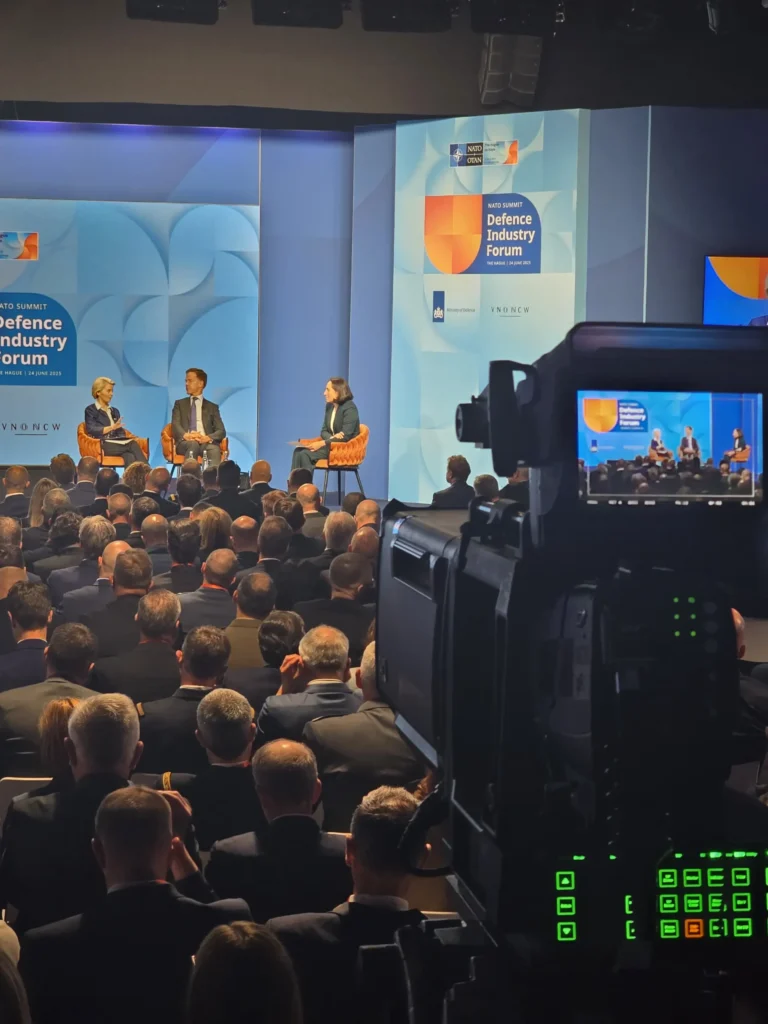
We know this city's big days. We covered the NATO Summit in The Hague in 2025 with camera crews and LiveU, filmed for the European Commission with Kaja Kallas in The Hague, and filmed European Parliament President Roberta Metsola in The Hague and Veldhoven in October 2026. For the ICC in detail, our page on the freelance cameraman at the International Criminal Court explains how a court day works for a crew.
A camera operator with full broadcast kit is €500 a day. A LiveU LU600 for a live position adds €350 a day. A shoot day is 8 hours including travel, and all prices exclude VAT. The full breakdown is on the ENG crew cost page.
Our crews work in English and Dutch. Interviews in other languages work well when your reporter leads them and we handle camera, sound and the feed.
A note on capacity. We own two LU600 units and can bring in two more, with three crews to run them. That means up to four simultaneous positions at a major event, two of them at short notice. For a big ruling, book ahead rather than calling on the morning.
To book, message a producer on WhatsApp, call +31 6 40830071, or send the date, the institution and the time through the quote page. For the kit and specs, see LiveU in The Hague. For other work in the city, book a camera crew in The Hague.
A ruling or press conference in The Hague? A camera operator with full kit is €500 a day, and a LiveU LU600 live position adds €350.
Book a crewQuestions, answered.
What is the difference between the ICJ and the ICC?
The International Court of Justice is the principal court of the United Nations. It settles disputes between states and sits in the Peace Palace. The International Criminal Court tries individuals for genocide, crimes against humanity, war crimes and the crime of aggression, in its own building on Oude Waalsdorperweg. The ICJ hears states; the ICC tries people.
Can a camera crew film inside the ICC or the ICJ?
Only on the institution's terms. Filming inside is very restricted, and at the ICC a crew is sometimes allowed in with a guide from the court. Whether a crew gets inside depends on the media outlet it works for and that outlet's accreditation, not on the crew.
How does press accreditation work for the Hague courts?
It is mostly an online application through the institution's press office. Some institutions also ask for a letter from your media outlet confirming the assignment. Have the letter ready and apply early.
Do the ICC and the ICJ provide a feed of hearings?
Yes. The ICC and the ICJ provide a feed of their proceedings, so you do not need your own camera in the courtroom. You need a crew outside for the delegations arriving, the handshakes and your live position.
Where do live positions happen at the Hague courts?
Mostly outside the buildings. A camera operator with a LiveU LU600 sets up where your correspondent needs to stand and goes live over bonded 5G and 4G, with no satellite truck.
Can you cover press conferences at the OPCW, Europol or Eurojust?
Yes, we have filmed at all three. If your accreditation gets the crew into the room, we film the conference with full broadcast kit. If it does not, we cover the arrivals and your live position outside.
What does a crew for a ruling day in The Hague cost?
A camera operator with full broadcast kit is €500 a day, and a LiveU LU600 for a live position adds €350 a day. A shoot day is 8 hours including travel. All prices exclude VAT.
Ruling coming up? Let's get your position set.
ENG crew and LiveU from The Hague. We have filmed at the ICJ, the ICC, the OPCW, Europol and Eurojust. Send the date and the institution and a producer replies within the hour.